

Fresno High-Speed Rail: What Track Installation Could Mean for Jobs, Tourism and Home Values
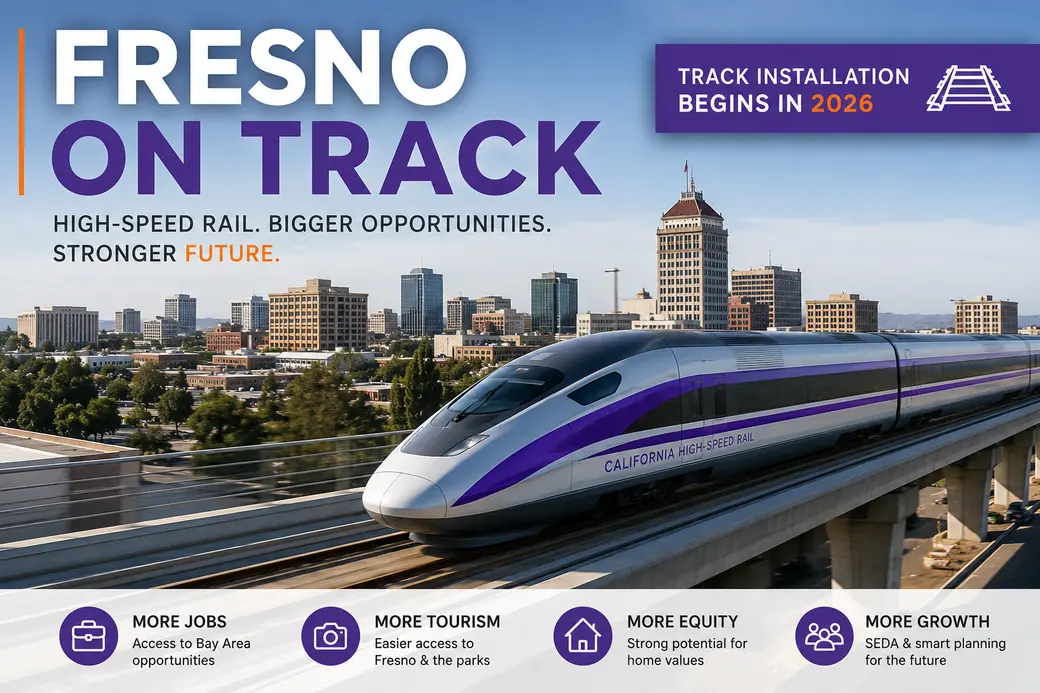
What Fresno Residents Need to Know About High-Speed Rail as Track Installation Begins
Finally, the conversation is moving from concrete structures to actual track—and Fresno may be positioned to benefit more than almost any other city in California.
California approved the team that will install high-speed rail track and operating systems through the Central Valley, with installation expected to begin in 2026. For Fresno, the long-term opportunity could include faster statewide access, higher-paying hybrid jobs, increased tourism, stronger housing demand and new investment around the downtown station.
Are They Really About to Lay High-Speed Rail Track in Fresno?
Yes—but the most accurate description is that California has approved the team responsible for turning the Central Valley guideway into an electrified railroad, and track installation is expected to begin in 2026.
On June 1, 2026, the California High-Speed Rail Authority approved an American-led consortium of Kiewit, Stacy Witbeck and Herzog to install the track, overhead electrical system, train controls and communications infrastructure. The contract covers the 119 miles currently under construction and is structured to extend toward Merced and Bakersfield.
That does not mean passenger service begins tomorrow. It does mean the project is entering a different and more visible phase.
Across our team at All Elite Homes, we hear the skepticism constantly—and we understand it. Fresno residents have lived with road closures, construction equipment and enormous concrete structures for years without seeing a train. Track, electrical equipment and operating systems are different. Those are the pieces that begin transforming a construction corridor into a railroad.
- 119 miles under active Central Valley construction Construction currently spans portions of Madera, Fresno, Kings, Tulare and Kern counties.
- 61 major structures completed as of June 2026 Bridges, viaducts, grade separations and underpasses have steadily created the physical corridor.
- Track and systems team approved The selected consortium will install rail, overhead power, train controls and communications.
- Testing remains a future milestone The Authority currently identifies 2028 as the planned beginning of testing on the initial electrified segment, although schedules may change.
Important distinction
Track installation does not mean the entire San Francisco-to-Los Angeles system is fully funded or close to opening. The first operating objective is the Merced-to-Bakersfield segment. Connections through Pacheco Pass to San Jose and north to San Francisco remain future phases with major funding, engineering and construction needs.
Why Fresno Could Be One of California’s Biggest Beneficiaries
Los Angeles and San Francisco are already global destinations, major employment centers and transportation hubs. Fresno is different. A dramatic reduction in travel time could change not only how people reach Fresno, but how they perceive its place within California.
Fresno has long been geographically central while remaining functionally distant from the state’s largest economies. We are close enough to the Bay Area, Los Angeles and the national parks to matter—but far enough away that driving time often limits spontaneous travel, employment access and tourism.
Across our team at All Elite Homes, we believe Fresno’s upside comes from that gap. A city that is already large, comparatively attainable and centrally located may gain more from becoming connected than a city that already has every connection.
Employment access
Some Fresno residents may be able to pursue Bay Area positions without permanently relocating.
Visitor access
Travelers may be able to add Fresno and the nearby national parks to a California itinerary more easily.
Housing demand
Fresno’s relative affordability may become more attractive when distance to larger markets feels smaller.
Our core view
Fresno does not need high-speed rail to turn us into San Francisco. The opportunity is for Fresno to remain Fresno while gaining better access to the jobs, visitors, capital and opportunities concentrated elsewhere in California.
Could Someone Really Live in Fresno and Work in San Jose?
Possibly—but the most believable use is hybrid work, not a five-day commute.
The California High-Speed Rail Authority has projected that a future Fresno-to-San Jose rail trip could take approximately one hour. An older system design benchmark estimated Fresno-to-San Francisco travel at approximately one hour and 29 minutes. Those are planned rail times, not guaranteed door-to-door commute times.
A resident would still need to reach the Fresno station, allow time to board and then travel from the destination station to the workplace. The final schedule, fares, stopping patterns and service frequency will also determine whether the trip is practical.
Across our team at All Elite Homes, we would never tell a buyer to base a home purchase on a promised commute that does not exist yet. We can, however, model what the opportunity may look like if the completed system performs near its stated travel goals.
Illustrative Fresno-to-San Jose Office Day
This example assumes a future one-hour rail trip and a workplace accessible from San Jose Diridon Station.
| Commute stage | Illustrative time | What may change it |
|---|---|---|
| Fresno home to downtown station | 20–30 minutes | Neighborhood, traffic, parking and local transit |
| Arrival and boarding buffer | 15–20 minutes | Security, train frequency and ticketing |
| Fresno to San Jose by rail | About 60 minutes projected | Stopping pattern and final operating plan |
| San Jose station to workplace | 20–40 minutes | Office location and connecting transit |
| Approximate one-way total | 1 hour 55 minutes to 2 hours 30 minutes | Illustrative—not a service promise |
Educational example only. Rates, taxes, and guidelines change frequently. Travel times, fares, routes and schedules are projections and may change before service begins.
At first glance, two hours sounds long. Yet residents of Los Angeles and the Bay Area regularly describe 60- to 90-minute commutes as manageable, while congestion can turn a longer suburban commute into two hours each way.
The difference is frequency. A nearly two-hour trip would be exhausting ten times per week. It becomes more realistic when an employee travels to the office once per week, twice per month or only for important meetings.
Traditional office schedule
Ten long-distance one-way trips every week would probably remain impractical for most Fresno households.
Hybrid office schedule
Two long-distance one-way trips per week—or a few per month—could be a very different calculation.
The rail portion may also be more usable than driving. Depending on onboard connectivity and employer expectations, a passenger may be able to answer email, prepare for a meeting, read or decompress instead of spending the entire trip behind the wheel.
Remote Work Did Not Disappear—It Became Hybrid
COVID-19 separated where many people lived from where their employers were located. For a period, a fully remote employee could live almost anywhere. Since then, many employers have asked workers to return to the office, but the result has not been a complete return to the old five-day model.
Bureau of Labor Statistics data showed that 22.6% of U.S. workers teleworked or worked from home for pay in March 2026. Separate BLS research has also shown a shift among teleworkers away from completing all work hours remotely and toward working a smaller portion of the week from home.
That dialing back of remote work could actually strengthen Fresno’s case.
Consider an employee who can work from a Fresno home three or four days per week but needs to be in San Jose occasionally. Today, the drive may be long enough to require an overnight stay, a relocation or passing on the opportunity entirely. A future one-hour rail connection could change that decision.
Across our team at All Elite Homes, we see the economic opportunity in two directions:
- Current Fresno residents could reach higher-paying positions that previously required moving to the Bay Area.
- Bay Area workers could consider Fresno housing while maintaining periodic access to an office, clients or professional network.
- Fresno businesses could reach outside clients more easily without treating every meeting as a full-day drive.
- Employers could access a wider labor pool while maintaining in-person collaboration on selected days.
The most valuable outcome would not simply be more people moving here. It would be more Fresno households earning larger checks from outside markets and spending more of that income locally—on homes, restaurants, childcare, services and neighborhood businesses.
The opportunity for existing residents matters most
The high-speed rail story should not be reduced to Bay Area buyers discovering less-expensive homes. A meaningful benefit would be helping people already rooted in Fresno reach careers, contracts, education and professional relationships that once required relocation.
High-Speed Rail Could Change Fresno Tourism
California tourism is heavily centered around Los Angeles, San Diego and San Francisco. Fresno often appears on the map as the place travelers pass through on the way to somewhere else.
High-speed rail may give Fresno a chance to change that.
A visitor who builds a trip around San Francisco could potentially board a train and reach Fresno in roughly the time it takes to navigate an airport, clear security and board a short flight. From Fresno, that visitor would be positioned near Yosemite, Sequoia and Kings Canyon national parks.
Across our team at All Elite Homes, we do not think the train automatically creates a tourism economy. Fresno will have to connect the downtown station to hotels, restaurants, events, rental transportation and park-bound services. But the train could remove one of our largest obstacles: the perception that Fresno is too far out of the way.
Downtown arrivals
Passengers could arrive near downtown, Chinatown, stadium events, restaurants and cultural destinations.
National park access
Fresno could become a practical staging point for Yosemite, Sequoia and Kings Canyon trips.
Longer visitor stays
Better connections may encourage travelers to spend a night, attend an event or add Central Valley experiences.
International research suggests that high-speed rail can support tourism, business travel and station-area development, but the benefits vary widely. Medium-sized cities within roughly one hour of larger cities may become more integrated into broader corridors for housing, employment and recreation.
That evidence is encouraging for Fresno, but it also carries a warning: accessibility creates an opportunity, not a guaranteed outcome.
The train cannot do all the work
Visitors still need a reason to exit the train. Fresno will benefit more if the station feels connected to downtown, transportation to the national parks is simple, and travelers can easily find compelling places to eat, stay and explore.
What Could High-Speed Rail Mean for Fresno Home Values?
Improved access can make a city more attractive to workers, employers, developers and investors. If high-speed rail meaningfully reduces Fresno’s economic distance from San Jose and San Francisco, demand for Fresno housing may increase over time.
That does not mean every house will immediately rise in value when the first piece of rail is installed. Home prices will continue to depend on mortgage rates, income growth, neighborhood supply, insurance, taxes, local jobs and the overall Fresno housing market.
The longer-term case is more straightforward:
- Fresno remains comparatively affordable when measured against much of the Bay Area.
- Improved transportation could make Fresno practical for more hybrid workers.
- Outside income may support additional local spending and housing demand.
- Downtown station investment may encourage apartments and mixed-use development.
- Buyers who establish roots earlier may gain potential equity if demand grows faster than supply.
Across our team at All Elite Homes, we see a home first as housing—not a stock certificate. A buyer should choose a payment, neighborhood and property that work under today’s conditions. High-speed rail can be part of the long-term optimism, but it should not be the only reason someone buys.
A Modest Housing Scenario
This is not a forecast. It shows how greater connectivity could influence demand over time.
| Potential change | Possible housing effect | What limits the effect |
|---|---|---|
| Faster access to San Jose | More hybrid workers consider living in Fresno | Fare, reliability and last-mile commute |
| More outside income | Additional purchasing power enters the local economy | Number and type of participating workers |
| Station-area investment | More downtown apartments and mixed-use projects | Development costs, zoning and infrastructure |
| Higher buyer demand | Potential support for home values and equity | New housing supply and broader market conditions |
Educational example only. Rates, taxes, and guidelines change frequently. Home values and equity are not guaranteed, and future transportation access may not affect all neighborhoods equally.
Buyers who share this long-term view can begin by exploring current Fresno-area homes for sale . Existing owners can also request a current estimate of their home’s market value before trying to measure any future impact.
Should you “strap in and buy a house”?
Maybe—but not because anyone can guarantee a high-speed-rail windfall. The better case is that Fresno still offers relative affordability, the project is becoming more tangible, and improved statewide access may support long-term demand. A sustainable payment and a home that meets your needs should come first.
Why Fresno Will Need More Housing—and Why SEDA Matters
Rising demand can create potential equity for existing homeowners, but it can also make purchasing harder for the next Fresno family. Connectivity is not an uncomplicated win if local wages and housing construction fail to keep pace.
This is one reason Fresno’s Southeast Development Area, commonly called SEDA, matters to the broader high-speed-rail conversation.
SEDA has been planned to accommodate approximately 45,000 homes and 37,000 jobs by 2050, with diverse housing types, mixed-use centers and a multimodal transportation network. Its final size, timing and implementation remain subject to public planning, infrastructure, financing and environmental processes.
Across our team at All Elite Homes, we see job access and housing supply as two sides of the same opportunity. Higher-paying employment could help Fresno households compete, while additional housing may help prevent new demand from being absorbed only through higher prices.
The potential benefit
Better employment access, outside investment and new residents may strengthen home values and Fresno’s tax base.
The balancing need
Fresno may need substantial housing construction so opportunity does not come at the cost of deeper affordability pressure.
SEDA alone will not solve every housing issue, and not all growth should occur on Fresno’s edges. Downtown infill, station-area apartments, established-neighborhood investment and a wider range of housing types also matter.
The goal should not be to suppress demand or prevent potential equity. It should be to expand opportunity while building enough housing for Fresno’s children, workers and future residents.
What Has to Go Right for Fresno to Capture the Opportunity?
High-speed rail can shorten distance, but Fresno still has to convert access into durable local value.
Across our team at All Elite Homes, we believe the city’s strongest outcome depends on several pieces working together:
- Reliable and reasonably priced service: A projected one-hour ride matters less if trains are infrequent or fares make regular use unrealistic.
- Easy station access: Residents need practical parking, local transit, safe walking routes and dependable connections.
- Downtown investment: The station should connect to housing, hotels, restaurants, businesses and public spaces.
- National park transportation: Visitors need a simple way to continue from Fresno to Yosemite, Sequoia and Kings Canyon.
- More housing: Fresno needs both infill development and thoughtful expansion to absorb potential demand.
- Local workforce development: Current residents should be positioned to qualify for the jobs and business opportunities improved access may create.
Research also shows that high-speed rail can increase both the inflow and outflow of talent. Larger, more-developed cities can capture an outsized share of the benefits when smaller station cities fail to create their own reasons to live, work and invest locally.
Fresno’s Future May Finally Be Coming Into View
It is fair to remain cautious. California High-Speed Rail has experienced delays, political conflict, changing cost estimates and significant funding challenges. Connections to San Jose, San Francisco and Los Angeles will require far more work after the initial Central Valley line.
But skepticism should also adjust when the facts change.
The corridor through Fresno is no longer only a proposal on a map. Structures are complete. Guideway exists. The track-and-systems team has been approved. Track installation is expected to begin.
Across our team at All Elite Homes, our optimism is not based on pretending every uncertainty has disappeared. It comes from recognizing what Fresno could gain if this infrastructure performs near its intended purpose.
A Fresno resident may be able to stay close to family, own a more attainable home and periodically reach a higher-paying Bay Area position. A visitor may be able to leave San Francisco, arrive downtown and use Fresno as the entrance to three national parks. A local homeowner may benefit from a city that feels closer to the rest of California.
Housing demand may rise. Affordability may face pressure. That is why additional jobs, downtown housing and long-term plans such as SEDA matter.
Finally, tracks are being laid. To Fresno’s future.
We may not know exactly when every part of the statewide system will open. We do know Fresno sits directly on the first major construction corridor—and that may place our city closer to the front of California’s next economic map than many people realize.
For additional local housing context, read our Fresno and Central Valley real estate market overview .
Frequently Asked Questions About Fresno High-Speed Rail
Across our team at All Elite Homes, these are the practical questions we expect Fresno homeowners and buyers to ask as track installation becomes more visible.
Is California actually laying high-speed rail track in 2026?
The California High-Speed Rail Authority approved the track-and-systems construction team in June 2026 and has stated that track installation is expected to begin during 2026. The work includes rail, overhead electrical power, train controls and communications. That is a major construction milestone, but it is not the same as beginning passenger service.
When will high-speed rail begin carrying passengers through Fresno?
A final passenger-service date has not been guaranteed. The Authority has identified 2028 as a planned starting point for testing the initial electrified Central Valley line. Testing, certification, train procurement, station completion, funding and construction progress will all affect when paying passengers can ride.
How long could the train from Fresno to San Jose take?
The Authority has projected a future Fresno-to-San Jose rail trip of approximately one hour. A commuter would still need to include travel to the Fresno station, boarding time and transportation from San Jose Diridon Station to the final workplace. Actual service times may differ from current projections.
Could Fresno residents commute to Bay Area jobs?
A daily five-day commute would probably remain demanding for most people. Hybrid arrangements may be more practical. Someone who works remotely most of the week and visits a San Jose office once weekly or several times per month could view the trip differently from someone making ten long-distance trips each week.
Will high-speed rail make Fresno home prices increase?
It may support demand over time, particularly if it improves employment access, tourism and investment. However, appreciation is not guaranteed. Mortgage rates, incomes, housing construction, neighborhood desirability and the broader economy will continue to influence Fresno home values.
Should I buy a Fresno home before high-speed rail opens?
A future transportation project should not be the sole reason to buy. A stronger decision is based on an affordable payment, adequate reserves, expected ownership timeline and a property that fits your needs today. Potential long-term benefits from improved connectivity can be treated as upside rather than a guarantee.
How could high-speed rail increase tourism in Fresno?
Faster access from the Bay Area and Southern California may make Fresno easier to add to a trip. Fresno could also serve as a gateway to Yosemite, Sequoia and Kings Canyon. The benefit will depend on hotels, local attractions, downtown investment and convenient transportation from the station to the parks.
What does SEDA have to do with high-speed rail?
If high-speed rail helps attract jobs, residents and investment, Fresno may need substantially more housing to limit affordability pressure. The Southeast Development Area has been planned for approximately 45,000 homes and 37,000 jobs by 2050. SEDA is only one part of the solution; downtown infill and housing in established areas also matter.
This article is for general educational purposes and is not financial, tax, legal, lending or investment advice. High-speed rail timelines, routes, travel times, fares, funding plans and economic impacts may change. Real estate values and equity are not guaranteed. Buyers should evaluate affordability using current loan terms, property information and professional guidance appropriate to their circumstances.
Categories
Recent Posts



GET MORE INFORMATION
