

How Much House Can I Afford in Fresno, CA? 2026 Guide
How Much House Can I Afford in Fresno, CA in 2026?
Your maximum approval and your comfortable home price are two different numbers.
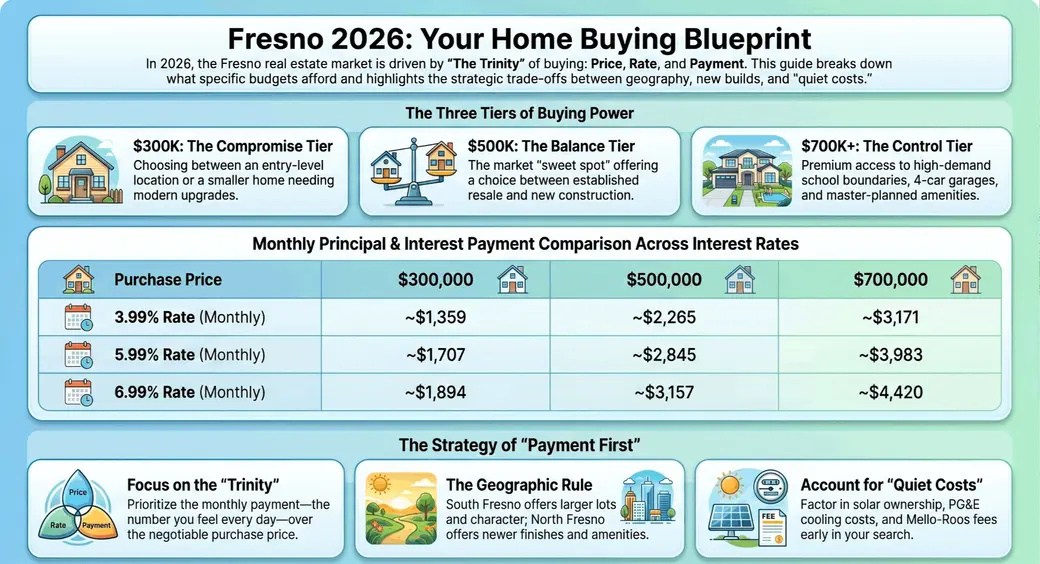
How much house you can afford in Fresno depends on your income, debts, down payment, interest rate, taxes, insurance, HOA or Mello-Roos, and your own comfort budget. Start with a monthly payment you can live with, then have lenders verify the financing. Compare the full payment—not just the purchase price.
First find the payment you want. Then find the price that creates it.
A mortgage pre-approval answers an important lending question: what may you qualify to borrow under a lender's guidelines? Your household still needs to answer a different question: what payment leaves enough room for the way you actually live?
Across our team at All Elite Homes, we call this the comfort number. We do not want to push a buyer to the top of an approval simply because a lender says the loan may qualify.
Choose a household comfort payment.
Look at take-home pay, childcare, vehicles, travel, savings, retirement goals, entertainment, subscriptions, food, and the amount of breathing room you want after the housing payment is made.
Compare lenders and get pre-approved.
We generally encourage buyers to speak with multiple lending professionals because programs, pricing, underwriting knowledge, and available loan structures can differ. The lender then verifies what your financial profile supports.
Add the property-specific costs.
Taxes, homeowners insurance, HOA dues, Mello-Roos or CFD assessments, mortgage insurance, and some solar obligations can materially change the monthly number from one property to the next.
Tour homes inside the verified range.
Once the financing and comfort range are aligned, the search becomes much more useful. You can compare condition, location, commute, new construction, resale, lot size, and lifestyle without guessing whether the house actually works financially.
Why we require financial clarity before private tours
A pre-approval can uncover credit or documentation issues early, gives everyone a realistic search range, and helps ensure occupied sellers are being asked to leave their homes for buyers who are positioned to purchase. Read our Fresno pre-approval guide for the full reasoning.
How much house can you afford on a $75K, $100K, or $150K income?
There is no responsible income-to-home-price shortcut because debt, down payment, loan program, taxes, insurance, interest rate, HOA dues, and credit profile can completely change the result. But an income-based housing budget can still provide an early planning range.
We use income ranges to start a conversation, not to hand someone a purchase-price promise. Your lender is the person who ultimately verifies the financing.
| Gross Household Income | Gross Monthly Income | 25% Housing Budget | 30% Housing Budget |
|---|---|---|---|
| $75,000/year | $6,250 | ~$1,563/month | ~$1,875/month |
| $100,000/year | ~$8,333 | ~$2,083/month | ~$2,500/month |
| $125,000/year | ~$10,417 | ~$2,604/month | ~$3,125/month |
| $150,000/year | $12,500 | ~$3,125/month | ~$3,750/month |
Educational example only. Rates, taxes, and guidelines change frequently. Fannie Mae describes roughly 25%–30% of gross income as a general housing-budget starting point, not a mortgage approval standard. Actual lender qualification may be higher or lower depending on the complete borrower profile.
Common Mistake: Turning an income table into a shopping budget
Someone earning $100,000 with no consumer debt, significant savings, and a large down payment is not in the same position as someone earning $100,000 with vehicle payments, student loans, revolving debt, and limited cash to close. The income is identical. The buying power is not.
A home price by itself does not tell you whether the home is affordable.
Interest rate and down payment determine how much of the purchase price becomes a monthly principal-and-interest payment. Property taxes, insurance, mortgage insurance, HOA dues, and assessments then get added to that number.
When we compare Fresno homes, we pressure-test the payment rather than assuming the lower-priced house is automatically the cheaper option.
The affordability equation
This is the simple version buyers should have in mind while searching.
Illustrative principal-and-interest examples
The table below shows why a rate change matters even when the home price does not. These examples assume 10% down and a 30-year fixed loan.
| Purchase Price | Loan After 10% Down | 5.50% | 6.50% | 7.50% |
|---|---|---|---|---|
| $350,000 | $315,000 | ~$1,789 | ~$1,991 | ~$2,203 |
| $425,000 | $382,500 | ~$2,172 | ~$2,418 | ~$2,674 |
| $500,000 | $450,000 | ~$2,555 | ~$2,844 | ~$3,146 |
Educational example only. Rates, taxes, and guidelines change frequently. Figures are approximate principal-and-interest payments only and exclude property tax, homeowners insurance, mortgage insurance, HOA dues, Mello-Roos/CFD assessments, solar obligations, and other property-specific costs. Sample rates are illustrations, not current rate quotes or offers to lend.
Two $425,000 Fresno-area homes can require very different monthly budgets.
The list price may be identical while the taxes, insurance, HOA, Mello-Roos, solar arrangement, utility exposure, and maintenance profile are completely different.
This is why our team reviews the actual property rather than telling a buyer that a certain list price automatically equals a certain payment.
Property Tax & Mello-Roos
Base property tax is only part of the tax bill. Some newer communities carry additional CFD or Mello-Roos assessments that can materially change the monthly housing payment.
Quote the Address
Insurance should be estimated for the specific home rather than using one generic Fresno number. Roof, age, condition, coverage, insurer, and underwriting requirements can matter.
PG&E & Solar
HVAC age, insulation, windows, solar ownership, EV charging, pool equipment, and household habits can make two similar homes operate very differently during a Fresno summer.
The mortgage is not the entire cost of living in the house.
We built a separate guide around this exact issue. Before stretching for another $25,000 or $50,000 of purchase price, compare the home's utilities, insurance, taxes, maintenance, solar, and transportation impact. Read what it really costs to operate a Fresno home .
Mello-Roos deserves particular attention because it can make a lower-priced newer home carry a higher monthly cost than a more expensive property with a different tax structure.
Our Fresno-area Mello-Roos guide explains how to verify these special taxes before you write an offer.
Skip the rigid “$300K neighborhood / $500K neighborhood” rules.
Fresno inventory changes too quickly for a permanent article to promise that a particular price buys a particular neighborhood, school assignment, lot size, or condition. A better approach is to understand which tradeoffs usually change as the budget moves.
We would rather show a buyer what is actually available today than build expectations around an article written months earlier.
Redfin reported a Fresno median sale price of approximately $404,780 for June 2026. That is a useful market anchor, but it is not a recommendation that you should spend $405,000—or proof that a $405,000 home fits your budget.
Expect More Tradeoffs
Buyers may need to compromise on condition, square footage, location, age, HOA structure, lot, or renovation needs. That does not make the home a bad purchase; it means inspection and repair budgeting matter more.
More Cross-Shopping
This is often where buyers can compare established resale homes against newer construction, different parts of Fresno and Clovis, or farther-out communities with different commute and ownership costs.
More Choice, Not Unlimited Choice
A larger budget may create more options for condition, lot, square footage, location, or finishes, but buyers still need to decide which of those priorities are actually worth paying for.
A hard price cap does not mean your only move is to increase the budget.
We have worked with buyers around a hard $325,000 ceiling where the available inventory was extremely limited. The goal was not to convince them that $350,000 or $375,000 was suddenly “close enough.” The goal was to make the search smarter.
Sometimes that means widening geography. Sometimes it means comparing a fixer against a renovated home. Sometimes it means knowing what may be coming back to market, understanding a seller's timeline, or comparing a new-build incentive against a resale home's repair needs.
Affordability strategy is not about finding creative language to justify spending more. It is about protecting the number while looking for more ways to solve the housing problem.
Across our team, one of the most valuable things we can do is respect the buyer's cap and use local knowledge to expand the options inside it.
A more expensive new build may have a lower initial payment—but compare the whole deal.
Builders may offer closing-cost credits, rate buydowns, or other incentives, frequently subject to particular financing or affiliate requirements. Resale sellers may also offer credits or concessions depending on the property and negotiation.
We compare the actual lender terms and property costs rather than assuming the largest advertised builder incentive is automatically the best deal.
Possible advantages
- Builder financing incentives may reduce cash needed or payment.
- Newer systems may reduce some near-term maintenance exposure.
- Energy efficiency may improve operating costs.
- Warranty coverage may help with qualifying covered items.
Possible advantages
- Established neighborhoods may offer larger lots or mature landscaping.
- The completed home and surrounding area are easier to evaluate today.
- A resale seller may negotiate price, repairs, credits, or other terms.
- Tax and HOA structures may differ significantly from newer communities.
Do not compare a temporary buydown payment with a permanent payment.
Some builder promotions may temporarily subsidize the payment for an introductory period. Make sure you understand the underlying note rate, when the subsidy ends, what the full payment becomes, and whether you would still be comfortable if refinancing never makes sense.
Before visiting a builder, read our Fresno, Clovis and Madera new-construction buyer guide so you can compare incentives, upgrades, lot premiums, inspections, first-visit representation rules, and the actual all-in number.
Affording the payment and affording the purchase are not the same thing.
A buyer can be comfortable with the monthly payment and still be underprepared for the cash required to successfully close and move.
We want buyers protecting reserves after closing instead of draining every available dollar simply because the down payment was technically possible.
Down Payment
The required amount depends on the loan program. Twenty percent is not a universal requirement.
Closing Costs
Lender fees, title, escrow, prepaid taxes, prepaid insurance, and other transaction costs need to be planned separately.
Inspections
General home, roof, HVAC, sewer, pool, pest, or other inspections may be appropriate depending on the property.
Reserves
Moving, repairs, appliances, furnishings, overlap with rent, and an emergency reserve still matter after the keys are handed over.
Fresno affordability questions buyers ask before touring.
We prefer giving buyers a range that can be verified rather than pretending one salary, rate, or online calculator can determine the right house price for everyone.
How much house can I afford in Fresno on a $100,000 salary?
There is no reliable purchase-price answer from income alone. A $100,000 household earns about $8,333 gross per month, and a 25%–30% general housing-budget range would be roughly $2,083–$2,500 per month. That is a planning range, not a loan approval. Existing debt, down payment, rate, taxes, insurance, HOA dues, credit, and loan program can move the actual qualifying amount significantly.
How much income do I need to buy a $400,000 home in Fresno?
It depends on the down payment, interest rate, monthly debt, property taxes, homeowners insurance, mortgage insurance, HOA or Mello-Roos, credit profile, and lender guidelines. A licensed lender should calculate the actual qualifying income. We recommend starting with the monthly payment you want to carry and then having multiple lenders show what loan structures may support it.
Should I use the maximum amount my lender approves?
Not automatically. A lender's approval is based on lending guidelines and the financial information provided. Your own budget may include childcare, travel, savings goals, hobbies, future expenses, or a preferred level of monthly breathing room that makes a lower purchase price more comfortable.
Do HOA dues and Mello-Roos reduce how much home I can afford?
They can. HOA dues and property-specific special assessments increase the recurring housing cost considered during qualification and also affect your household's real monthly budget. This is why two homes with the same purchase price may support different financing outcomes.
Is a lower-priced Fresno home always cheaper per month?
No. Taxes, insurance, HOA dues, Mello-Roos, mortgage insurance, solar obligations, interest rate, maintenance needs, and utility exposure can cause the lower-priced property to have the same—or sometimes a higher—monthly cost.
Can a builder rate buydown help me afford more house?
It may lower the monthly payment depending on the specific promotion and lender terms, but temporary and permanent buydowns work differently. Buyers should compare the note rate, APR, points, lender fees, credits, future payment, and cash needed to close rather than focusing only on the advertised introductory payment.
Should I wait for mortgage rates to fall before buying in Fresno?
Nobody can reliably promise where mortgage rates will move or when. Waiting may make sense for some buyers and not for others. The more useful question is whether today's available home, payment, cash requirement, and ownership costs fit your finances and expected time horizon without depending on a future refinance.
What should I do before touring Fresno homes?
Set a comfortable monthly housing budget, speak with multiple lenders, get a current pre-approval, identify your available cash for the purchase and reserves, and then work with your agent to build a search around properties whose complete monthly cost fits that verified range.
Do not start with “What is my max price?” Start with “What payment lets me keep living my life?”
All Elite Homes can help you map the real-estate side of the equation: current Fresno-area inventory, new construction versus resale, taxes, Mello-Roos, HOA dues, solar, property condition, commute, and the tradeoffs behind the numbers. Then your licensed lender verifies the financing.
Categories
Recent Posts









GET MORE INFORMATION
