

Cost of Living in Fresno, CA (2026): Homeowner Costs
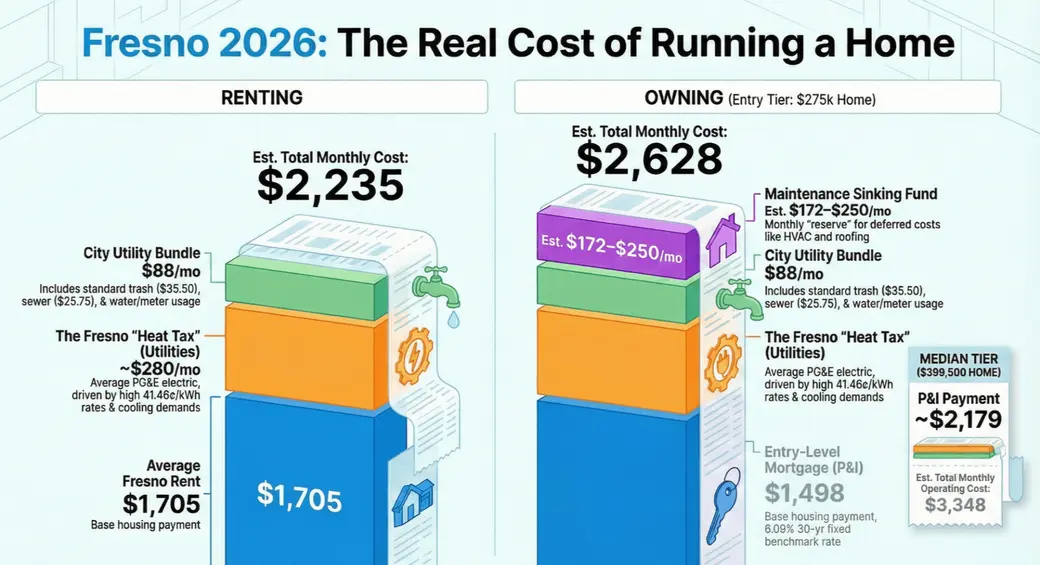
Cost of Living in Fresno, CA in 2026: What Homeowners Actually Pay
The mortgage gets you into the house. The operating costs determine how comfortably you can live in it.
To budget for a Fresno home in 2026, add more than the mortgage: property taxes, homeowners insurance, PG&E, City of Fresno utilities, internet, HOA or Mello-Roos when applicable, and a maintenance reserve. Summer cooling can be the biggest variable, so compare each home's operating costs before deciding what payment actually feels affordable.
Do not ask only, “Can I afford the mortgage?”
A lender has to evaluate whether you qualify for the loan. Your household has a different question: what will this particular home require from your budget every month after you own it?
Across our team at All Elite Homes, we want buyers comparing the full monthly stack before they get emotionally attached to a house, because two similar mortgage payments can create very different lifestyles.
Housing Cost
Principal and interest, property taxes, homeowners insurance, mortgage insurance when applicable, HOA dues, and special assessments.
Home Utilities
PG&E, water, sewer, trash, community sanitation, internet, irrigation, and other recurring services tied to the property.
Maintenance Reserve
HVAC, roof, plumbing, appliances, paint, irrigation, electrical components, and all the smaller repairs that arrive over time.
Risk Management
A home warranty may make sense for some homes with aging covered systems, while other owners may prefer to self-fund a larger repair reserve.
The All Elite Homes Household Operating Cost
This is the number we want buyers thinking about when one home appears cheaper than another.
Common Mistake: Comparing Only the Mortgage
A house with a payment that is $200 lower may stop looking cheaper if it also carries substantially higher summer electricity use, insurance, assessments, landscaping costs, or near-term repair exposure.
I thought I wanted a new house. What I really wanted was lower overhead.
Around 2020, my own Fresno household was getting hit with summer PG&E bills around $600 to $700. At the same time, my SUV was consuming roughly $300 per month in gasoline, sometimes more. Instead of immediately solving the problem by buying another house, I started looking at the household as one operating system.
I purchased the solar system rather than using a lease or power purchase agreement, and I also traded the gas SUV for an EV. Some later PG&E months were roughly $120, I was no longer spending the old gasoline amount, and my auto insurance was approximately unchanged. Even after considering the new vehicle and solar payments, I estimated the combined household change was saving me roughly $50 to $100 per month at the time.
The more important change was not the spreadsheet. It was comfort. Fresno summers can be brutal. The National Weather Service lists Fresno's all-time record high at 115°F, and extended stretches above 100°F are part of life here.
I did not want to spend July sitting under a ceiling fan with some Ampersand ice cream, trying not to move because I was worried about what another hour of air conditioning might cost. I wanted to live in my house normally in August, just like I would in February.
The lesson was not “everyone should buy solar.”
The lesson was that sometimes reducing your cost of living means spending strategically. Your answer might be solar, a more efficient HVAC system, different insurance, a smaller yard, a shorter commute, better insulation, or simply a different house. We want to identify the expensive problem before recommending the expensive solution.
Historical note: solar incentives and economics have changed significantly since my 2020 purchase. Federal rules applicable at the time allowed a 26% credit for qualifying solar property under the applicable requirements. Current IRS guidance states the Residential Clean Energy Credit is not available for property placed in service after December 31, 2025. Tax situations vary; consult a qualified tax professional.
PG&E can make two similar Fresno homes feel financially different.
Square footage does not tell you the whole energy story. HVAC age, insulation, duct condition, windows, orientation, shade, thermostat habits, solar configuration, battery storage, pool equipment, and EV charging can all change how much electricity a household buys from the grid.
When we compare homes, we do not stop at “this one has solar.” We want to understand who owns the system, how it is financed, what it produces, what the utility history looks like, and how the buyer expects to use electricity.
Efficiency
An older HVAC system, poor insulation, leaky ducts, large west-facing windows, or significant air leakage may increase cooling demand.
Usage
Work-from-home schedules, thermostat settings, EV charging, pool equipment, family size, and time-of-use behavior can change the bill.
Contract Matters
Owned free-and-clear, separately financed, leased, and PPA solar are not interchangeable from a payment, underwriting, title, or appraisal perspective.
Shopping Tip: Search for Paid-Off Solar, Not Just “Solar.”
Solar may help lower a home's electricity exposure, but the word “solar” in a listing does not tell you enough. Ask whether the equipment is owned free and clear, financed, leased, or subject to a PPA. Then review the agreement, production information, utility history, transfer provisions, and any remaining obligation.
Solar also does not automatically add its installation cost to a home's resale value. Fannie Mae requires appraisers to analyze market reaction rather than make a dollar-for-dollar adjustment. Under Fannie Mae guidance, third-party leased or PPA solar generally cannot be included in the appraised value of the property.
For California customers under the newer Net Billing Tariff, electricity imported from the grid and excess generation exported back to the grid are valued differently. That makes system design, household consumption, and timing more important than a simplistic “solar equals free power” assumption.
Water, sewer, trash, and the yard belong in the affordability conversation.
City of Fresno utility billing can include water, sewer, solid waste, and community sanitation. Water includes a service component plus consumption, so the house and the yard can influence what you pay.
Across our team, we pay attention to the boring features too: oversized lawns, old irrigation, pools, mature landscaping, and visible leaks can matter to a buyer's monthly budget even though none of them change the mortgage rate.
Sewer, Trash & Sanitation
Residential sewer and community sanitation are generally more predictable, while solid-waste charges depend in part on the service configuration. City rates can change, so use the current fee schedule when budgeting.
Water & Irrigation
Household consumption, irrigation, leaks, lot size, landscaping, and seasonal watering can make the water side more variable than buyers expect.
Do Not Compare a Tiny Yard and a Huge Yard as if the operating cost is identical.
A larger lot can be exactly what you want. It may also mean more irrigation, landscaping, equipment, maintenance, and time. The right choice depends on whether those extra costs buy a lifestyle you actually value.
Your mortgage rate may be fixed. Your homeowners insurance premium is not.
Insurance pricing can change from renewal to renewal, and different carriers can price similar risks very differently. Coverage should be compared on more than premium alone: deductibles, dwelling coverage, exclusions, endorsements, claims handling, and insurer requirements matter too.
Our practical advice is to review the policy at every renewal and consider fresh comparison quotes every few years, or sooner after a major increase, non-renewal notice, roof replacement, renovation, or another meaningful change.
Read the Change
Look at premium, deductible, coverage limits, exclusions, endorsements, and any new inspection or property-condition requirements.
Shop Comparable Coverage
A cheaper quote is only useful if the coverage still fits the property and your risk tolerance. Compare like-for-like whenever possible.
Quote the Address
Do not rely on a generic Fresno insurance estimate. The specific home, age, condition, roof, claims history, location, and carrier guidelines can change the quote.
Insurance is an operating cost worth auditing.
The California Department of Insurance explicitly encourages consumers to shop around because premiums can vary by hundreds of dollars. The best comparison is not simply “who is cheapest?” but “what am I paying, what am I getting, and what risk am I keeping?”
Maintenance is not a surprise just because you do not know which month it will happen.
Roofs age. HVAC systems eventually need service or replacement. Water heaters fail. Irrigation breaks. Appliances stop working. A responsible ownership budget gives those future expenses somewhere to land.
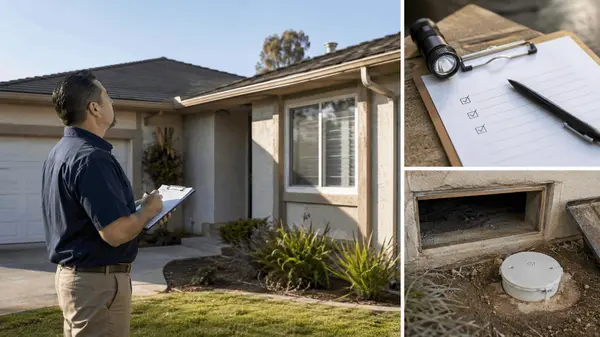
When we help buyers review inspections, we look at remaining life and near-term risk—not just whether an item happens to be working on inspection day.
Self-Fund a Repair Reserve
Set money aside monthly so routine repairs and future replacements do not have to become credit-card emergencies.
Consider a Home Warranty
A home warranty may make sense when a property has aging covered systems or appliances and the contract provides useful protection for the risks you are most concerned about.
A home warranty is not “everything that breaks is covered.”
California's Department of Insurance warns consumers to review exclusions, conditions, dollar limits, service fees, and covered components carefully. Air conditioning may require specific or additional coverage. A home warranty also does not replace homeowners insurance.
In Fresno, HVAC coverage deserves special attention. If an older air conditioner fails during triple-digit weather, the problem can move from inconvenient to urgent. Before paying for a warranty because of an aging AC, confirm that the specific system qualifies, what the contract excludes, what the service fee is, and what repair or replacement limits apply.
During a purchase, buyers can also ask whether a home warranty may be negotiated as part of the transaction. Whether that makes sense depends on the property, offer terms, seller position, contract, and actual warranty coverage.
The lower-priced house can still be the more expensive house to live in.
This hypothetical comparison shows why All Elite Homes prefers an all-in monthly comparison rather than stopping at purchase price or principal and interest.
We use this kind of comparison as a decision tool, not as a prediction of what a specific house will cost. The real numbers should come from the actual property, lender, insurer, tax records, utility information, inspection, and disclosures.
| Monthly Category | Home A: Lower Housing Payment | Home B: Higher Housing Payment |
|---|---|---|
| Mortgage + tax + insurance | $2,900 | $3,100 |
| HOA / CFD | $0 | $150 |
| Planning estimate: energy | $450 | $175 |
| City utilities + internet | $200 | $200 |
| Maintenance reserve | $350 | $150 |
| Planning total | $3,900 | $3,775 |
Educational example only. Rates, taxes, and guidelines change frequently. Utility usage, insurance, maintenance, solar performance, HOA dues, assessments, and actual property costs vary significantly.
That is the entire point.
Home B looks $200 more expensive when you look only at the housing payment. In this hypothetical example, the complete operating budget makes it $125 less expensive each month. This will not happen with every comparison, but it is why the question deserves to be asked.
Sometimes the house changes costs that are not technically “house bills.”
A location can affect transportation, commute time, school transportation, tolls, vehicle mileage, and how often your household drives for everyday needs. Those expenses do not appear on the mortgage statement, but they still leave the same checking account.
We do not tell clients which commute or neighborhood is “worth it.” We help them see the tradeoff so they can decide whether the house saves enough—or improves life enough—to justify the difference.
Closer Home
May cost more to buy but reduce mileage, fuel, charging, vehicle wear, and time spent commuting.
Farther-Out Home
May offer more house or a different price point, while increasing transportation cost and time.
Electric Household
An EV can shift part of the transportation budget into the electric bill, which makes home energy strategy more connected to transportation than many buyers realize.
Ask one surprisingly useful question: do I need another house, or do I need this house to cost less?
Moving can absolutely be the right decision. But if the frustration is primarily financial, audit the current household first. Sometimes the expensive problem is the mortgage. Sometimes it is insurance, energy, transportation, maintenance, or a combination.
My own experience changed how we think about this at All Elite Homes. Sometimes the right real-estate advice starts with recognizing that selling the house is not the only lever available.
Audit the Current House
- Insurance renewal and competing coverage
- HVAC condition and efficiency
- Insulation and window exposure
- Solar ownership and production
- Water and irrigation use
- Transportation costs
- Near-term repairs
Compare the Next Home Properly
- New mortgage structure
- Property taxes and assessments
- Insurance quote
- PG&E exposure
- HOA / Mello-Roos
- Maintenance profile
- Commute and transportation change
Build the complete affordability picture.
We connect these topics because the purchase price is only one part of whether a home actually fits.
Fresno cost-of-living questions homeowners and buyers actually ask.
We prefer property-specific answers whenever possible, because averages are useful for orientation but your actual house is what sends you the bill.
How much does it cost per month to own a home in Fresno?
There is no single reliable citywide monthly number because mortgage amount, interest rate, property taxes, insurance, HOA or Mello-Roos, PG&E usage, water, maintenance, and solar arrangements vary by property and household. A better method is to add the required housing payment to the property's likely monthly operating costs before comparing homes.
What is a normal PG&E bill for a Fresno home?
A single “average” can be misleading. Fresno electricity use can vary substantially based on HVAC age, insulation, home size, windows, thermostat habits, solar, EV charging, pool equipment, and summer temperatures. When possible, review utility history for the specific property and adjust for how your household expects to use the home.
How much do water, sewer, and trash cost in Fresno?
City of Fresno utility bills may include water, sewer, solid waste, and community sanitation. Water includes a service component and a consumption component, while other residential services may be more predictable. Rates can change, so use the current City of Fresno utility schedule rather than an old online estimate when budgeting a specific home.
How often should I shop my homeowners insurance?
We recommend reviewing your coverage at every renewal and considering competing quotes every few years or whenever you receive a meaningful premium increase, non-renewal notice, or make a significant property change. The California Department of Insurance encourages consumers to shop around. Compare coverage, deductibles, exclusions, limits, and insurer quality—not premium alone.
Is a home warranty worth the cost for a Fresno home?
It may be useful for some buyers, particularly when a home has aging covered systems or appliances and the contract's exclusions and limits still provide meaningful protection. It may be less useful when systems are newer or when the owner would rather self-fund repairs. If an aging air conditioner is your main concern, confirm that the specific AC system and failure type are covered before relying on the warranty.
Is a Fresno home with paid-off solar worth more?
Owned solar may contribute to market value, but it should not be assumed to add value dollar-for-dollar with the system's original cost. Fannie Mae requires appraisers to analyze market reaction. Leased and PPA solar are treated differently and generally cannot be included in the appraised value under Fannie Mae guidance. Always verify the system's ownership and financing structure.
Does solar still make sense in Fresno in 2026?
It depends on the house, system price, household electricity use, financing, current California net-billing rules, system design, battery strategy, and expected ownership period. Solar can still reduce electricity purchased from the grid, but the economics should be modeled rather than assumed. Also note that current IRS guidance says the federal Residential Clean Energy Credit is not available for property placed in service after December 31, 2025.
Is it cheaper to rent or buy in Fresno in 2026?
It depends on your purchase price, financing, time horizon, rent alternative, maintenance risk, taxes, insurance, utilities, and how long you expect to stay. Renting can offer simpler short-term cost predictability, while ownership may provide more control and potential equity over time. A fair comparison should use the full cost of each option rather than rent versus mortgage alone.
Before you ask “Can I afford this house?” ask what it costs to live in it.
Send All Elite Homes the Fresno, Clovis, Madera, or Central Valley homes you are comparing. We can help you organize the mortgage, taxes, insurance, HOA or assessments, solar situation, utility exposure, inspection findings, and maintenance profile so you can compare the real monthly picture.
Categories
Recent Posts








GET MORE INFORMATION
